
Most visitors to Hiriketiya never leave the bay – and you can see why. But within a short tuk-tuk ride there are temples, a sculpture reef, a blowhole and beaches where you will have the sand almost to yourself. Here are the places worth the detour, starting with the closest.
Minikirula Raja Maha Viharaya
A Buddhist temple on the hill above Nilwella. Locals call it the highest point in Nilwella, and the view over the area is the reason to come. It is a different temple from the small one by the sea next to Blue Beach Island. Ask a tuk-tuk driver for “Minikirula Raja Maha Viharaya” – it is inland, less than a kilometre from The Nest in Udawela. Go early in the morning or late in the afternoon, when it is cooler and the light is softer.
The Nilwella Underwater Gallery
Just off Blue Beach Island lies a sculpture “town” on the seabed, built by the Sri Lanka Navy and opened in April 2021. It also works as an artificial reef for fish and coral. On calm days you can snorkel over it from the island, or dive it with Hiri Divers, the dive centre at Blue Beach. It is best for confident swimmers. More in the Blue Beach Island guide.
Wewurukannala Vihara
About 3 km from Hiriketiya by road, on the Beliatta road in Dikwella, sits one of the largest seated Buddha statues in Sri Lanka – around 50 metres tall, as high as an eight-storey building. The temple also has a “Tunnel of Hell”: a covered walkway with life-sized models of demons and sinners being punished, meant to show the consequences of bad karma. It is graphic, so think twice with small children.
There is a small entrance fee, so bring cash. Dress modestly: cover your shoulders and knees, and wear shoes that are easy to slip off.
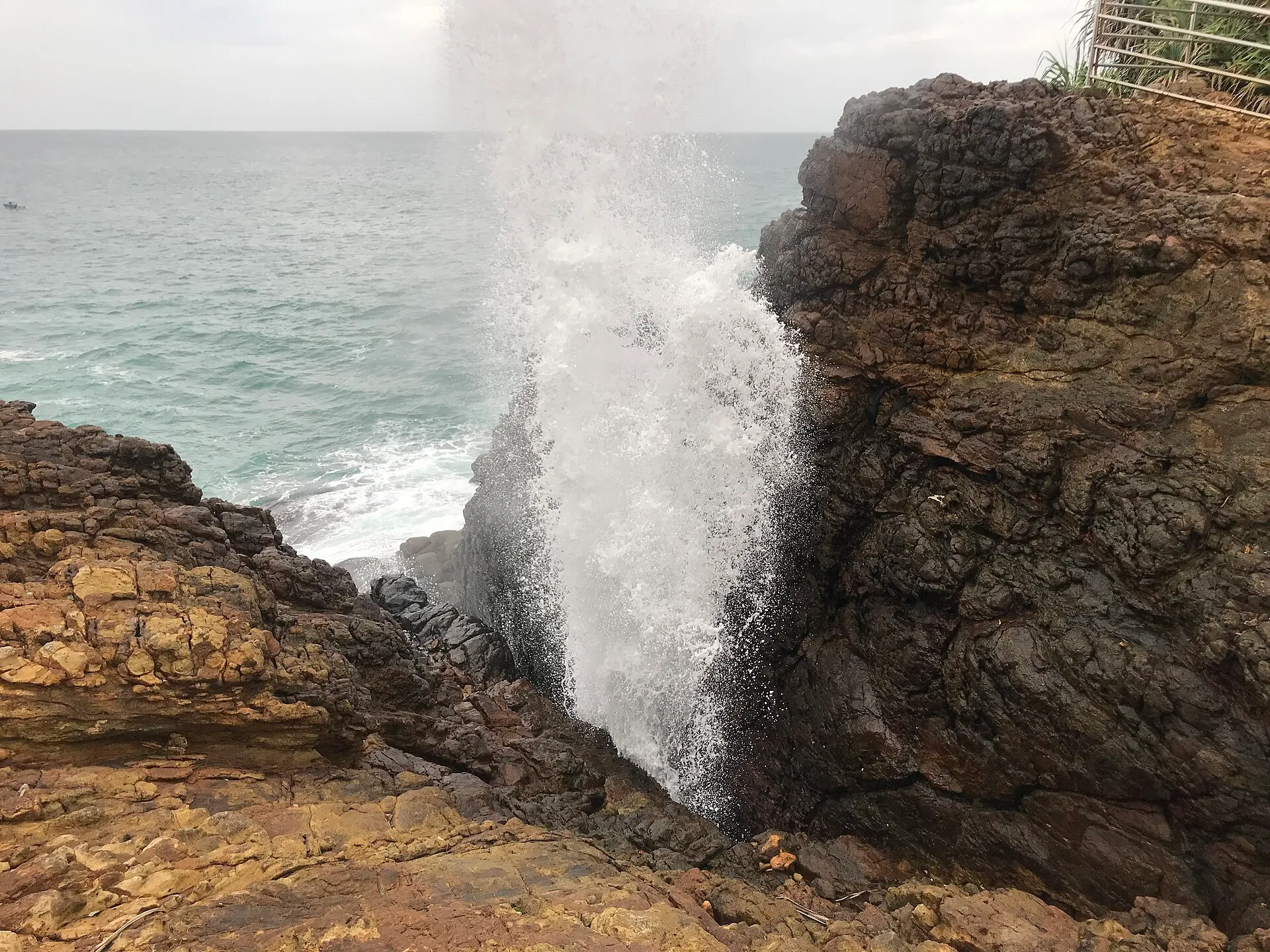
Hummanaya Blowhole
At Kudawella, about 6 km east of Hiriketiya by road, the sea is forced up through a hole in the rocks. In big swell the spray can reach 25–30 metres, with a loud “hoo” that gives the place its name. It is the only known blowhole in Sri Lanka. On a flat sea you may see little more than mist, so go when the waves are up – usually during the southwest monsoon, from May to October.
There is a small entrance fee and a visitor centre. From the parking area it is a 10–15-minute walk with steps and rocky sections, so wear proper shoes.
Mulkirigala rock temple
About 24 km inland by road – roughly half an hour by car – is one of the most impressive temples in the south. Mulkirigala is a 205-metre rock with seven cave shrines on five terraces, full of Kandyan-era paintings and Buddha statues, including a large reclining Buddha. The chronicles credit its founding to King Saddhatissa, more than 2,000 years ago. Around 500 steps lead up through the terraces, so go early, before the heat, and bring water. It is not accessible by wheelchair.
Turtle watching at Rekawa
About 20 km east by road, beyond Tangalle, the beach at Rekawa is a nesting beach for wild sea turtles – all five species found in Sri Lanka have been recorded there. A community conservation project runs guided night watches from its visitor centre, and a guide takes you down to the beach when a turtle comes ashore to lay her eggs. Tours usually start around 8 pm. Sources name March or April to July as the peak season, and a sighting is never guaranteed. Turtles are easily disturbed by light, so follow the guide’s instructions.